

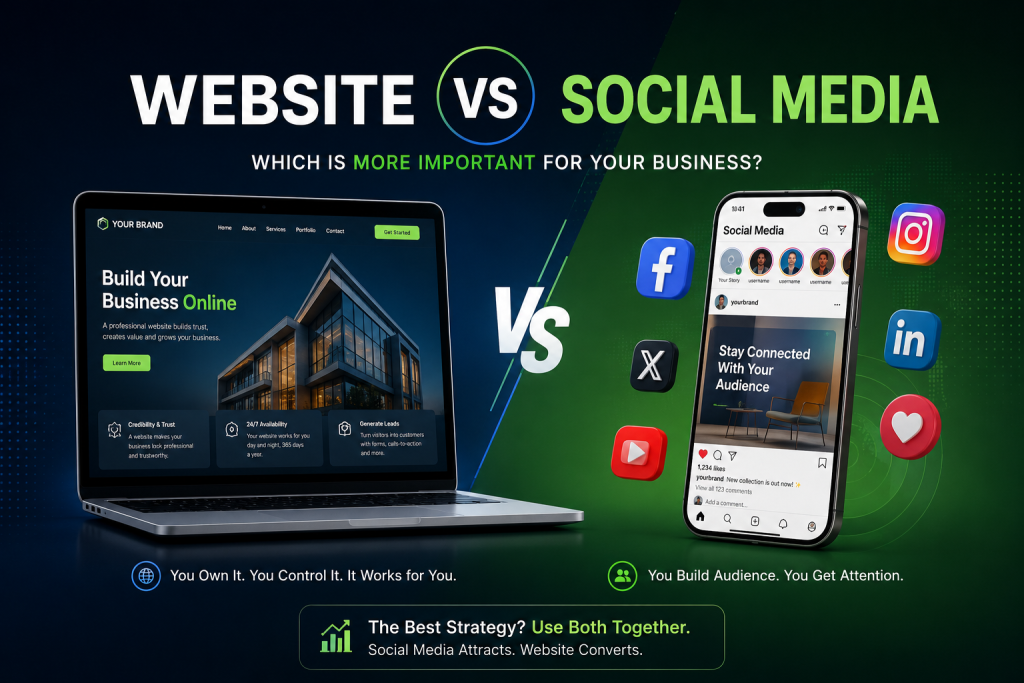
Website vs social media is a common debate among business owners in 2026. While social media helps businesses engage with audiences, a professional website remains the foundation of a strong online presence.
Should I invest in a website or focus on social media?
It’s a fair question. After all, social media platforms like Facebook, Instagram, LinkedIn, and X (Twitter) have millions of active users. They allow businesses to connect with customers, showcase products, and build a loyal audience.
At the same time, a professional website remains one of the most valuable business assets you can own.
So, which one is more important?
The answer might surprise you.
The Power of Social Media
There’s no denying the impact of social media. It has completely transformed the way businesses communicate with customers.
With a social media account, you can:
- Share updates instantly
- Promote products and services
- Engage directly with customers
- Build a community around your brand
- Run targeted advertising campaigns
- Increase brand awareness
For many businesses, social media is often the first point of contact with potential customers. A person may discover your business through an Instagram post, a Facebook ad, or a LinkedIn article.
The biggest advantage of social media is visibility. It helps people find you.
However, visibility alone doesn’t always lead to sales.
The Limitation of Social Media
Many business owners make the mistake of relying entirely on social media.
At first, everything seems fine. They gain followers, receive likes, and generate engagement.
But there’s one major problem.
You don’t own the platform.
Your business is operating on someone else’s property.
Social media platforms constantly change their algorithms. A post that reached 5,000 people last year may reach only a few hundred people today.
Accounts can be restricted, hacked, suspended, or even permanently removed.
If a platform changes its rules tomorrow, your business has very little control over the outcome.
That’s why relying solely on social media can be risky.
Why a Website Still Matters
A website is different.
Unlike social media, a website belongs to your business.
You control:
- The design
- The content
- The customer experience
- The branding
- The lead generation process
Your website acts as your digital headquarters.
It’s available 24 hours a day, 7 days a week.
Potential customers can learn about your business, browse products, read testimonials, request quotes, book appointments, or make purchases whenever they want.
A professional website also builds trust.
Think about your own behavior as a customer.
When you discover a new business on social media, what’s one of the first things you do?
You visit their website.
If the website looks professional, loads quickly, and provides useful information, you immediately feel more confident about the business.
If there’s no website, many people become hesitant.
The Trust Factor
Trust is one of the biggest reasons businesses need a website.
Customers today are more cautious than ever.
Before making a purchase or contacting a company, they often research online.
A website helps answer important questions:
- Who are you?
- What services do you offer?
- Where are you located?
- How can customers contact you?
- What do previous customers say about you?
A well-designed website provides these answers instantly.
This credibility can make the difference between gaining a customer and losing one to a competitor.
Websites Help You Get Found on Google
Another major advantage of having a website is search engine visibility.
When people search for services online, they usually start with Google.
For example:
- “Best salon near me”
- “Web design company”
- “Fashion clothing brand”
- “Real estate services”
A properly optimized website can appear in search results and attract customers who are actively looking for your products or services.
Social media profiles can appear in search results too, but websites generally provide much greater opportunities for long-term search engine growth.
Social Media Brings Traffic. Websites Convert It.
One of the easiest ways to understand the relationship between websites and social media is this:
Social Media = Discovery
Website = Conversion
Social media helps people find your business.
Your website helps them take action.
For example:
A customer discovers your clothing brand through Instagram.
They like your products.
They click the link in your bio.
They visit your website.
They browse your collection.
They place an order.
Without the website, that journey often ends before a sale is made.
Why Successful Businesses Use Both
The most successful businesses don’t choose between a website and social media.
They use both together.
Social media drives attention.
Websites build trust.
Social media starts conversations.
Websites generate leads.
Social media creates awareness.
Websites create conversions.
When combined, they create a powerful digital marketing system.
Final Thoughts
The debate between websites and social media isn’t really about choosing one over the other.
Both serve different purposes.
Social media is excellent for reaching people, building relationships, and increasing brand awareness.
A website provides credibility, control, visibility on search engines, and a place where visitors can become customers.
If you’re serious about growing your business in 2026 and beyond, the smartest approach is to use social media to attract attention and a professional website to convert that attention into real business results.
Because while social media trends come and go, your website remains your business’s most valuable digital asset.